The Gulf Cooperation Council states have turned education technology into a strategic budget line. Saudi Arabia alone allocated SR 195 billion (USD 52 billion) to education in its 2024 national budget – roughly 16% of total government spending. The UAE, Oman, and Qatar are running parallel programs under their respective national visions, each channeling public funds into smart classrooms, adaptive learning platforms, and AI-driven student tools. The result is a regional EdTech market that IMARC Group valued at USD 12.3 billion in 2025, with a projected CAGR of 9.25% through 2034.
This spending has made the Gulf a magnet for education exhibitions. Vendors, school operators, and ministry procurement teams now converge at a handful of marquee events each year to evaluate products ranging from learning management systems and VR lab simulations to AI tools that solve physics problems step by step – platforms like physics solver applications that deliver instant, explained homework help and are increasingly visible on exhibition floors across the region.
Below is a practitioner-level guide to the exhibitions that matter most in 2026, what each one offers, and how to extract maximum value from attending.
What Are the Biggest EdTech Exhibitions in the Gulf in 2026?
Five events anchor the Gulf’s education technology calendar this year: GESS Dubai, GESS Saudi Arabia, EDGEx Riyadh, LEAP, and GITEX Global. Each serves a distinct audience and buying cycle. The following breakdown covers their scope, dates, and specific relevance to educators, EdTech vendors, and institutional buyers.
What Is GESS Dubai and Why Does It Anchor the Gulf EdTech Calendar?
GESS – Global Educational Supplies and Solutions – is the Middle East’s longest-running dedicated education exhibition. The 2026 edition runs November 10-12 at Dubai World Trade Centre (DWTC), organized by Informa Connect. The event draws over 7,500 education professionals from 74 countries, with approximately 550 exhibitors and 179 speakers across multiple stages.
GESS Dubai’s distinguishing feature is its pure education focus. Unlike broader tech conferences that bolt on an EdTech track, every exhibitor and every session here relates directly to learning: AI-supported educational software, STEM kits, inclusive learning materials, early-years resources, school furniture, and campus security systems. The conference program is CPD-accredited, making it one of the few Gulf events where teachers earn professional development credits on-site.
Attendance is free for education professionals – a deliberate choice by the organizers to maximize buyer footfall. This makes GESS the most accessible entry point for teachers and school administrators who want to evaluate products without budget approval for a conference ticket. The event also runs the GESS Education Awards, recognizing standout products and institutional projects across the MENA region.
For EdTech vendors selling to K-12 and higher education institutions in the UAE and broader GCC, GESS provides the most concentrated pool of end-user decision-makers: principals, heads of procurement, department leads, and curriculum coordinators.
How Does GESS Saudi Arabia Extend That Platform into the Kingdom?
Building on the Dubai edition’s model, GESS Saudi Arabia returns to Riyadh on September 29 – October 1, 2026. The event mirrors the Dubai format – free-to-attend exhibition, CPD-accredited conference, and the same emphasis on practical classroom solutions – but is calibrated specifically for the Saudi market.
The distinction matters. Saudi Arabia’s education system enrolls over 6.5 million students in public schools alone, with an additional 1.3 million in higher education. The Ministry of Education is the single largest institutional buyer of educational products in the Gulf. GESS Saudi Arabia positions exhibitors directly in front of that procurement apparatus, alongside school leaders navigating the Kingdom’s rapid curriculum digitization.
What Is EDGEx and Why Should Education Companies Pay Attention?
The Education Global Exhibition (EDGEx) is organized by the Saudi Ministry of Education as part of the Human Capability Initiative (HCI) conference. The 2026 edition takes place May 3-5 at the Ritz-Carlton Hotel in Riyadh, under the theme of advancing human capabilities in the age of AI.
EDGEx 2025 drew over 20,000 visitors and featured 100 technology companies, 40+ universities and educational institutions, and resulted in roughly 40 signed agreements and memoranda of understanding. The 2026 edition will run alongside the HCI conference, which convenes 250 speakers including policymakers, corporate executives, and academic experts.
What sets EDGEx apart from commercial exhibitions is its government pedigree. This is the Saudi Ministry of Education’s own showcase, which means exhibitors interact with the actual procurement decision-makers at the ministry level – not intermediaries. For companies with products aligned to Vision 2030’s education reform pillars (digital transformation, STEM integration, AI adoption), EDGEx offers a direct channel to the Kingdom’s education policy infrastructure.
How Does LEAP Cover Education Technology Within Its Broader Tech Scope?
LEAP, Saudi Arabia’s flagship technology conference, has been rescheduled for August 31 – September 3, 2026, at the Riyadh Exhibition and Convention Center in Malham. Founded in 2022 by the Ministry of Communications and Information Technology (MCIT), the Saudi Federation for Cybersecurity, Programming and Drones (SAFCSP), and Tahaluf (an Informa company), LEAP has grown rapidly: the 2024 edition hosted 215,000 visitors and 1,800 exhibitors, while LEAP 2025 maintained comparable scale with over 201,000 attendees.
LEAP’s EdTech relevance lies in its scope. The conference covers fintech, health tech, gaming, smart cities, space technology, and education – which means EdTech companies exhibit alongside AI infrastructure providers, cloud platforms, and enterprise software firms. For education startups seeking investment, LEAP’s Rocket Fuel pitch competition has awarded $1 million in prizes at each edition. The event also co-hosts DeepFest, the region’s dedicated AI conference powered by the Saudi Data and AI Authority (SDAIA), where education-specific AI applications receive dedicated stage time.
LEAP is the right venue for EdTech companies positioning their products within broader AI and digital transformation narratives rather than selling exclusively to schools.
Where Does GITEX Global Fit for Education Technology?
GITEX Global 2026 marks a turning point for the event: it relocates to Expo City Dubai and shifts to December 7-11, with a new GITEX Scale Summit opening day focused on AI policy. The move to a December slot aligns the event with Dubai’s peak tourism season and the venue’s $2.7 billion expansion into the region’s largest purpose-built indoor events facility.
GITEX’s 2025 edition attracted over 200,000 visitors from 180+ countries and 6,800+ exhibiting companies. Education technology occupies a dedicated vertical within the broader exhibition, sitting alongside cybersecurity, cloud computing, 5G infrastructure, and smart city solutions. For EdTech firms, the value of GITEX is cross-sector exposure: products designed for classrooms can be positioned to corporate training buyers, government digital skills programs, and international development agencies, all of which attend in volume.
The addition of the TechCation concept – a blend of citywide tech activations and the main exhibition – signals GITEX’s evolution from a trade show into a broader tech ecosystem event, which may dilute its focus for pure education buyers but expands addressable audience for EdTech vendors targeting multiple verticals.
Why Is the Gulf Investing So Heavily in Education Technology?
The GCC EdTech market was valued at USD 3.02 billion in 2024 and is projected to reach USD 4.47 billion by 2030, growing at a CAGR of 6.74%. The broader Middle East and Africa education technology market generated USD 14.4 billion in revenue in 2024. These numbers are driven by structural factors, not cyclical spending.
How Do Vision 2030 and Vision 2040 Shape EdTech Demand?
Saudi Vision 2030 treats education digitization as a prerequisite for economic diversification. The Human Capability Development Program – the implementing body behind EDGEx – has explicit mandates around AI in education, digital skills acquisition, and TVET (Technical and Vocational Education and Training) modernization. Saudi Arabia’s government has pledged close to $100 billion to advance AI infrastructure, research, and adoption, with education as one of the primary application domains.
The UAE’s strategy runs in parallel. Internet penetration in the UAE stands at 99%, with mobile internet speeds ranking first globally at 134.48 Mbps. This infrastructure baseline makes digital education deployment frictionless. Smart learning programs, digital classrooms, and national e-learning platforms are active across all emirates.
Oman Vision 2040 targets a knowledge-based economy built on human capital development, with education technology investments concentrated in STEM curricula, teacher training digitization, and campus connectivity. The Oman Convention and Exhibition Centre (OCEC) in Muscat has become a regional venue for technology and education events, positioning Oman as a secondary hub after the UAE and Saudi Arabia.
How Much Capital Is Flowing into Gulf EdTech Startups?
MENA EdTech venture funding jumped 169% in Q1 2025 compared to the same quarter of 2024, even as global EdTech investment contracted. Total venture capital deployed into MENA education startups since 2010 has reached approximately $690 million. Saudi Arabia saw a particularly sharp surge: EdTech startup funding in the Kingdom rose 2,069% in 2022 alone, catalyzed by post-pandemic digital learning adoption and government-backed accelerator programs.
Over 2,300 EdTech startups are now active across the MENA region, spanning K-12 e-learning, test preparation, adaptive tutoring, corporate upskilling, and AI-based homework assistance. The UAE and Saudi Arabia together account for around 40% of the region’s most promising EdTech ventures, according to HolonIQ’s 2024 MENA EdTech 50 ranking. Major rounds in recent years include Classera’s $40 million Series A and sizable investments in Jordan’s Abwaab, Saudi Arabia’s Noon Academy, and the UAE’s Lamsa.
What AI-Powered Tools Are Being Showcased at Gulf Education Fairs?
AI has moved from a peripheral exhibit category to a central theme across every major Gulf education event. GESS Dubai dedicates a full stage to AI, immersive technology, AR, and VR in education. LEAP co-hosts DeepFest with explicit EdTech AI sessions. EDGEx 2026 frames its entire program around human capability in the AI era.
The product categories attracting the most floor traffic and buyer interest:
- Adaptive learning platforms – use machine learning to adjust content difficulty, pacing, and question types based on individual student performance. Deployed at scale in Gulf schools where class sizes and multilingual student populations create acute differentiation challenges.
- AI tutoring and problem-solving tools – including instant homework solvers for physics, mathematics, and chemistry that provide step-by-step explanations rather than bare answers. These address a specific pain point in STEM education: students stuck on problem sets outside classroom hours, with no access to a tutor. The tools function as on-demand study partners, breaking down complex equations and physics scenarios into sequential reasoning steps.
- VR/AR immersive learning environments – lab simulations, historical reconstructions, and spatial reasoning training. Gulf schools, particularly in the UAE and Qatar, have been early adopters of VR headset deployments in science classrooms, and exhibition booths offering hands-on VR demos consistently draw the longest visitor queues.
- Arabic-language content platforms – localized LMS systems and digital curricula designed for Arabic-medium instruction, filling a gap that global EdTech products often overlook.
- Robotics and coding kits – physical STEM products (programmable robots, circuit boards, maker-space equipment) that pair with software platforms for blended learning and are a staple of the GESS exhibition floor.
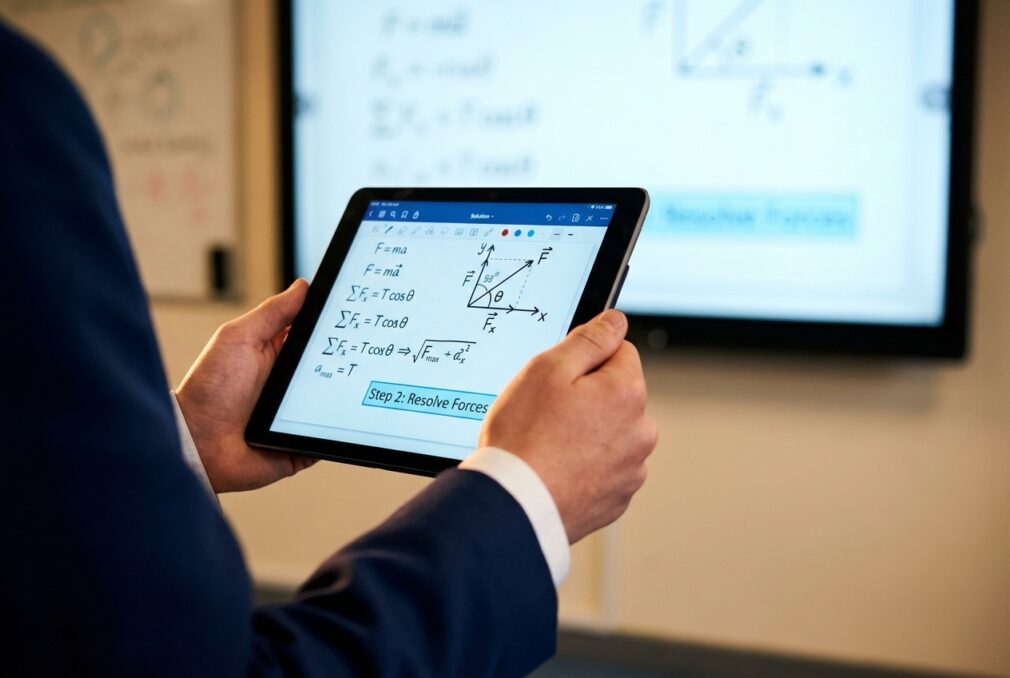
How Are AI Homework Solvers Changing STEM Education?
The core shift is pedagogical. Traditional homework assigns problems and checks answers. AI solvers reframe the process: a student photographs or types a physics problem, the tool parses the question, identifies the relevant principles, and generates a worked solution with each step annotated. The student reviews the method, not just the result.
This approach aligns with constructivist learning theory – the student actively traces reasoning rather than passively copying an answer key. Gulf education ministries have begun evaluating these tools for integration into official digital learning portals, particularly for subjects where teacher shortages make individualized tutoring impractical at scale.
Exhibition attendees report growing interest from school procurement teams in tools that combine problem-solving engines with analytics dashboards – showing teachers which topics and which steps cause the most student difficulty, enabling targeted classroom intervention.
How Do Gulf EdTech Exhibitions Compare – Which One Should You Attend?
The choice depends on your role, target market, and sales cycle. The table below summarizes the key differences at a glance.
| Event | Dates 2026 | Location | Visitors | Free Entry | Best For |
| EDGEx | May 3-5 | Ritz-Carlton, Riyadh | 20,000+ | Yes | Government procurement, ministry-level MoUs |
| LEAP | Aug 31 – Sep 3 | RECC Malham, Riyadh | 200,000+ | Tiered | Startup investment, cross-sector AI positioning |
| GESS Saudi Arabia | Sep 29 – Oct 1 | Riyadh | TBA | Yes | Saudi school buyers, CPD-accredited training |
| GESS Dubai | Nov 10-12 | DWTC, Dubai | 7,500+ | Yes | K-12 product evaluation, teacher networking |
| GITEX Global | Dec 7-11 | Expo City, Dubai | 200,000+ | Tiered | Multi-vertical EdTech, corporate training buyers |
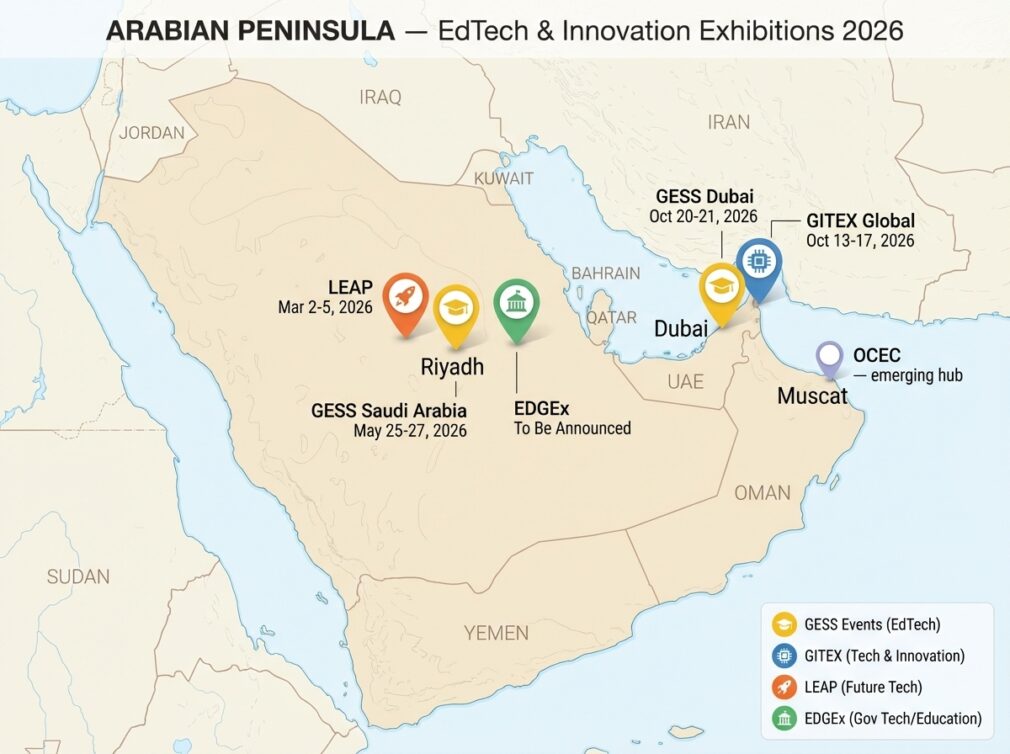
Teachers and school administrators benefit most from GESS Dubai and GESS Saudi Arabia – free entry, practitioner-focused sessions, and a purely educational exhibitor base make these events efficient for classroom decision-makers. EdTech startups seeking investment should prioritize LEAP, where the 2024 edition attracted over 1,600 investors with a combined AUM of $4.89 trillion. Companies targeting Saudi government contracts will find EDGEx the most direct channel, given its Ministry of Education pedigree and track record of on-site MoU signings. Vendors selling across education, corporate training, and government skilling programs get the broadest buyer mix at GITEX Global, though education-specific visitors make up a fraction of its total audience.
How Do You Plan a Visit to a Gulf EdTech Exhibition?
Registration for all five events is handled online, and visitor entry is free at GESS Dubai, GESS Saudi Arabia, and EDGEx. LEAP and GITEX offer tiered registration depending on access level (exhibition floor, conference sessions, VIP networking).
Do You Need a Visa, and What Should You Know About Travel Logistics?
The UAE offers visa-on-arrival or e-visa access to citizens of over 100 countries. Saudi Arabia’s e-visa system has expanded considerably since 2019 and now covers most nationalities for event attendance. Processing times are typically 24-72 hours for electronic applications. Check current eligibility on the official portals before booking flights.
For GESS Dubai and GITEX, hotels near DWTC and Expo City Dubai fill early – book at least six weeks in advance. For LEAP and GESS Saudi Arabia in Riyadh, hotels near the Riyadh Exhibition and Convention Center (Malham) are limited; budget for a 20-30 minute commute from central Riyadh if booking late. EDGEx at the Ritz-Carlton in Riyadh is more centrally located and easier to access via short taxi rides from most Riyadh hotels.
Internal flights between Gulf cities (Dubai-Riyadh, Muscat-Dubai) typically run under two hours, making multi-event attendance feasible within a single trip. Several Gulf carriers offer convention-rate fares when booked through official event pages.
How Can You Maximize Networking and ROI at a Gulf Exhibition?
Whether you are visiting or exhibiting, these practices consistently yield the best results at Gulf education events:
- Pre-book meetings through each event’s matchmaking platform – GESS, LEAP, and GITEX all offer dedicated B2B scheduling tools that let you lock in time with specific exhibitors or buyers before the doors open.
- Arrive on opening day for keynotes, which set the thematic context and draw the highest concentration of senior attendees.
- Reserve at least half a day for unstructured floor walking – the most actionable product discoveries happen at mid-size booths away from headline sponsors.
- Carry bilingual business cards (English and Arabic). Formal meetings in the Gulf typically begin with relationship-building conversation before transitioning to business specifics – factor this into your scheduling, as 30-minute slots may feel rushed.
- Prioritize live product demonstrations over slide decks. Gulf education buyers respond strongly to real-time demos, especially for AI and interactive tools. If your product can run on-booth, that outperforms any printed brochure.